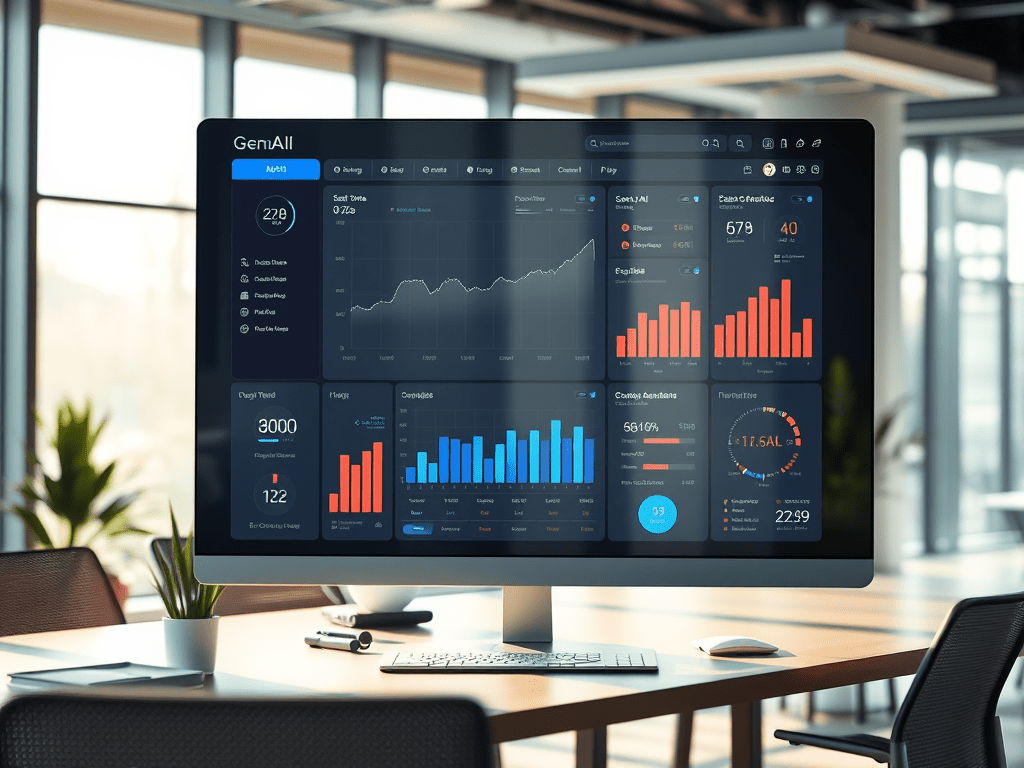
Your Personal GenAI Assistant: It’s Not a Dream — It’s Here
First, let’s get a few facts straight if you’re in the consumer goods industry:
- Practical GenAI applications exist today, and you should already be using them.
- We’re still in the early stages, but the potential value is limitless.
Let’s start with what’s possible right now.
The most widely recognized GenAI solutions are tools like ChatGPT or Dialogflow, which are used for customer service, product recommendations, and handling general inquiries. Predictive tools exist for trend forecasting and product prototype generation. If you’ve shopped at IKEA, you may have seen their augmented reality (AR) apps, which let you visualize furniture in your home.
These applications are excellent examples of how far we’ve come in just a few years.

The Operational Reality of GenAI
From an operational perspective, GenAI has evolved to the point where you can have your own AI assistant providing actionable insights into:
- Why something happened,
- How to fix it, and most importantly,
- What to do today to prevent it from happening again.
This is a significant leap from just a few years ago, when technology couldn’t explain what was happening behind your KPIs. The sheer amount of data generated in retail makes it impossible for humans to identify and connect the dots between variables. The shift from “something happened” to “this is why it happened” is already here.
Now, everyone is racing to make this incredible technology practical.

A Practical Example of GenAI in Action
Imagine you’re a Chief Supply Chain Officer reviewing last week’s KPIs. You notice a 3% unexplainable sales drop. What do you do?
Typically, you’d reach out to the relevant supply chain or merchandising director. They’d investigate, loop in planners or analysts, and manually try to figure out the root cause. In most cases, the answers are vague: “There was less foot traffic,” or “We ran out of stock on Item X,” or “The promotions didn’t work as expected.”
How long did that process take? How many people were involved? Were the conclusions actionable?
Now imagine using GenAI. You open your KPI dashboard, spot the 3% sales drop, and ask your AI assistant, “Hi, I noticed a 3% sales drop. Can you explain why?” Within seconds, you get a response:
“The drop was primarily driven by two factors:
- Out-of-stock issues: Two items contributed over $100,000 in lost sales.
- Item A was unavailable in eight locations due to supplier X not delivering the full order quantity.
- Item B was out of stock because of under-forecasting, which resulted in insufficient inventory at the distribution centers.
- Promotion inefficiencies: Four promotions ran during the week, generating negative true lift. For instance, Promotion X performed well but cannibalized Product Y, resulting in a net negative impact.”
You get the idea.
This level of insight revolutionizes efficiency. It eliminates wasted time and frees up teams to focus on higher-value tasks. It also reduces reaction time to operational challenges.

What’s Next?
Now that GenAI can uncover meaningful relationships across millions of data points, the possibilities are limitless. In the short to medium term, you can start feeding GenAI any data you have and receive actionable, practical insights.
Here are some emerging ideas of what is very close to be next:
- Dynamic Pricing Optimization: Imagine using GenAI to continuously analyze demand patterns, competitor pricing, and customer preferences in real-time to dynamically adjust your prices and maximize profitability while maintaining customer satisfaction.
- Hyper-Personalized Marketing Campaigns: GenAI could analyze consumer behavior, purchase history, and preferences to create personalized marketing campaigns at scale, recommending tailored products and promotions that are more likely to convert.
- Sustainability Insights: AI could analyze your supply chain and operations to identify opportunities to reduce waste, lower emissions, or source more sustainable materials—turning sustainability into a measurable and actionable business advantage.
- Voice-Activated Planning Tools: Imagine supply chain or merchandising professionals interacting with planning tools using voice commands, enabling instant insights and adjustments without complex manual processes.
- Real-Time Consumer Feedback Loops: AI could analyze live customer feedback from social media, surveys, or reviews to inform immediate operational adjustments or new product developments.
These are just a few of the directions GenAI could take. What makes this technology exciting is its ability to not only react to what’s happening today but also proactively shape better business outcomes tomorrow. The key is identifying the right use cases that align with your strategy and will deliver real, practical value.
 From AI to ROI
Leave a comment