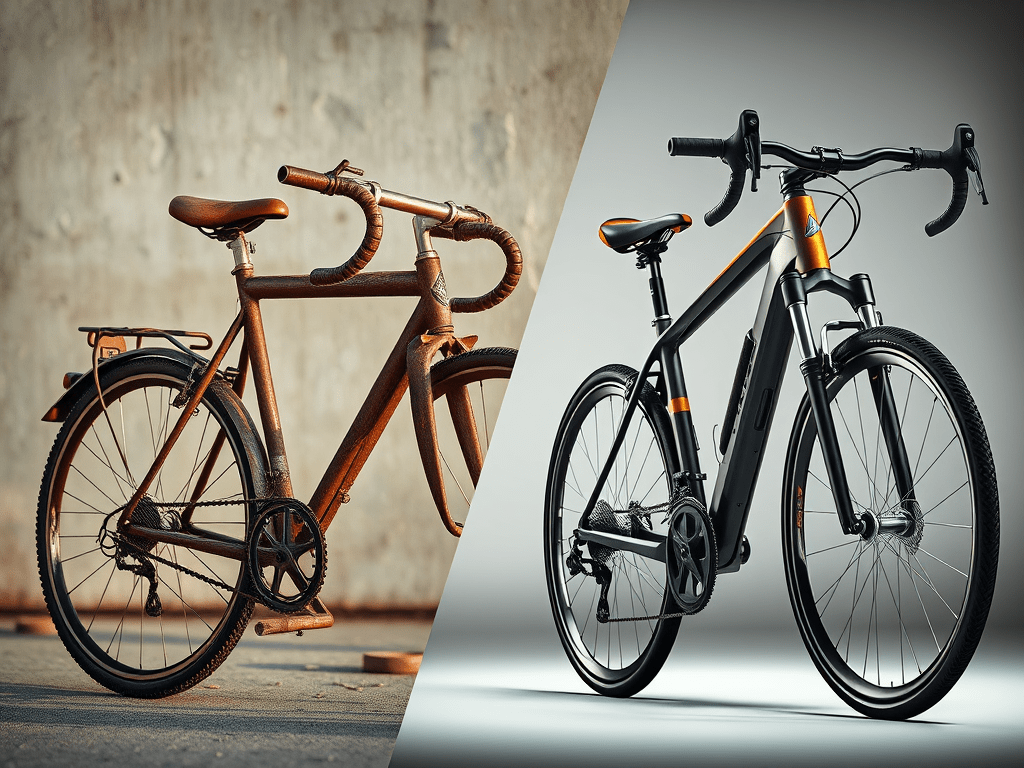
Picture this: you’ve had the same bike for years. It’s scratched, the gears slip now and then, and the brakes squeak. But it still gets you from A to B, so you keep fixing it — a new chain here, a little oil there.
That’s how most companies treat their technology.
Legacy systems that were once cutting-edge are now patched together with manual workarounds and spreadsheets. It’s not pretty, but it works — mostly. Until one day, it doesn’t.

🚲 Why We Keep Riding the Rusty Bike
It’s not because leaders don’t see the problem. It’s because they’re human.
Here’s why most organizations can’t stop pedaling:
1. The Sunk Cost Trap
“We’ve already invested so much in this system.”
Sound familiar? Just like the cyclist who spent a fortune on their old frame, companies struggle to abandon tech that once defined their success.
2. Fear of Disruption
Upgrading feels risky. What if the new system causes downtime? What if the team resists? The irony is, clinging to outdated tools is often the bigger risk — it just feels safer because it’s familiar.
3. Incremental Thinking
Many businesses prefer “fixing” over “rebuilding.” But layering quick fixes over old architecture only hides deeper inefficiencies.
4. Misaligned Incentives
In many organizations, success is measured by short-term savings rather than long-term agility. The result? Teams optimize cost instead of competitiveness.

🏁 The Cost of Standing Still
While you’re busy maintaining your old bike, your competitors are upgrading — lighter frames, smarter components, more aerodynamic setups. You might compensate by pedaling harder (and yes, even the best tech can’t replace the power in your legs), but here’s the truth: technology amplifies that power.
It’s what turns effort into speed, and good performance into winning performance. In business terms, AI and modern technology don’t replace your people or processes — they make them more effective, more adaptive, and far more competitive.
Winners are investing in AI-driven automation, predictive insights, and flexible platforms that learn and adapt.
These companies move faster — not (at least not solely) because they pedal harder, but because their machines are built for speed.

⚙️ How to Break Free
The lesson isn’t just “buy a new bike.” It’s about changing how you decide when it’s time to upgrade.
Let’s take a cue from professional cycling — or any elite sport. At that level, competition is brutal. The difference between winning and not winning is often a matter of small, continuous improvements. Every season starts on a blank slate. Teams that stop innovating fall behind — fast.
Now, think about retail (or any competitive industry): the same rules apply. You can’t rely on what worked last year. You need a process for constant renewal — one that blends data, experimentation, and courage.
Here’s what that looks like in practice:
- 1. Challenge the sunk cost fallacy
Past investments don’t justify future inefficiency. Don’t be the team racing on last year’s frame. Evaluate your systems based on future value, not past cost.
- 2. Adopt an “Always-Evolving” Mindset
Instead of waiting for the next big transformation program, shift to continuous improvement. Schedule regular technology and process reviews — quarterly, not yearly.
- 3. Balance Quick Wins with a Long-Term Vision
Identify small upgrades that deliver measurable results (automation, better forecasting, cleaner data). But anchor them in a larger roadmap toward flexibility and scalability.
- 4. Build a Culture of Innovation
Reward smart risk-taking and experimentation. Innovation shouldn’t be an event — it should be a habit.
- 5. Choose Flexible, Cloud-Based Solutions
Modular platforms let you evolve gradually without blowing up your operations. Think evolution, not revolution.
- 6. Seek Outside Perspective
Bring in fresh eyes — consultants, partners, or even AI diagnostics — to spot inefficiencies you’ve learned to live with.
These actions create an environment where technology renewal becomes part of your company’s DNA, not an occasional crisis response.

💡 Bottom Line
The Rusty Bicycle Problem keeps companies moving — but slowly, inefficiently, and always one bump away from breakdown.
Those who cling to outdated tech won’t be able to seize the opportunities that AI-driven, modern supply chains bring. Those who know when to stop patching and start investing in future-proof solutions will ride faster, smoother, and further.
The real question isn’t whether your bike still works.
It’s whether it can actually take you where you need to go.
👉 In the next post, we’ll explore exactly how to make that decision — and why the traditional way of building a business case for new technology is already broken.
 From AI to ROI
Leave a comment